
For many patent attorneys, design patents are like the strange relatives that live in another state. They don’t really understand them, but since they only show-up once or twice a year they can be tolerated. Indeed, in 2014 only 38 law firms in the United States obtained more than ten design patents all year,[1] and 16 utility patent applications were filed for every one design patent application.[2] As an inventor, then, your patent attorney may not even broach the subject of design patents. And if you don’t know to ask about them yourself, you may miss out on an important tool in your arsenal against your competitors.
First, some background. As a Registered Patent Agent, I frequently hear the question, “Do I need a patent to sell my product?” The answer is “No,” a patent is not a license to make and sell a product. Rather, a patent is a license to stop someone else from making and selling a product. Now why would the US Government give you the right to stop some other citizen from making and selling something? It has to do with progress, and the government has an interest in promoting progress because that’s what drives the economy. If you, as an inventor, agree to fully disclose how to make and use your product in a published US Patent, then you get a limited monopoly on that product so that other smart inventors will read your patent, put their thinking caps on, and come up with better, improved ways of solving the same or similar problems (if they can). That’s progress, and in exchange you get a monopoly that’s limited in time (15 years for design patents, and right around 17 years for utility patents).
I love design patents for three main reasons: they’re relatively inexpensive, they are allowed by the Patent & Trademark Office (PTO) much more frequently, and they are granted more quickly than utility patents. We’ll explore each of these areas in detail as we move along, but first it’s important to know the difference between design and utility patents. Briefly, utility patents protect how an invention works--that is, the utilitarian functions of an invention--while a design patent protects the appearance of a product, or it’s ornamental or aesthetic attributes. For example, if you develop a unique design for a pair of sunglasses, you would want a design patent to protect that style or look. That’s why Oakley files dozens of design patents each year.
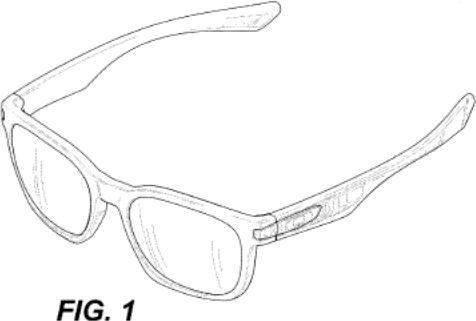
On the other hand, if you were the first person to invent polarized lenses for eyeglasses, then you would want a utility patent to protect how those lenses work to reduce glare. In this situation you don’t really care about what your competitor’s glasses look like; if they’re using polarized lenses you want to be able to stop your competitor in court. A design patent does not protect against a competitor who is copying how your product works if they have significantly changed the way the product looks. This is often fairly easy to do.
Not unreasonably, then, it has been considered through the years that utility patents are stronger than design patents, since prior to 2008 infringers of design patents had to be making virtually identical copies of your product to infringe your design patent. And it’s still true that utility patents are considered stronger than design patents. But apparently word hasn’t completely trickled down yet about the good news in the 2008 Egyptian Goddess v Swisa decision concerning the increased strength of design patents. This decision affirms that the “ordinary observer” test is the sole test to use to determine if a competitor is infringing your design patent. If an “ordinary consumer” would be confused between your product and that of your competitor’s, based on the appearance of each and how crowded the prior art landscape is, then you may very well have a good case against them with your design patent.
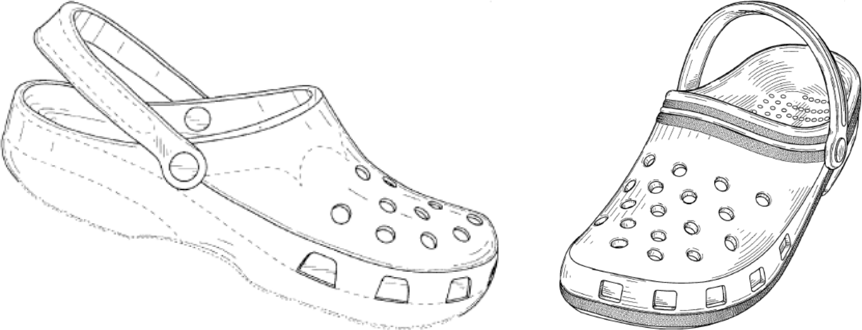
For example, in the 2010 Federal Circuit case Crocs v ITC, Crocs’ design patent for a pair of sandals was determined to be infringed by a competitor even though there were differences in the structure of the two sandals.
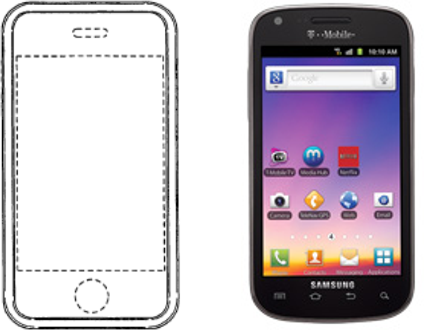
Similarly, Samsung was recently stung by a huge $500,000,000 verdict for infringing Apple’s iPhone patents (although the latest word is that one of these design patents may be invalid after reexamination):
Clearly design patents can be enforceable and valuable. But should you file a design patent on your product? It depends on a number of considerations. First, is your product the type of thing that can be design patented? Does it have a particular and distinct physical appearance? If so, and if that aesthetic distinctness would be difficult to change without changing the way the product functions (that is, if in your case form follows function to some extent), then having a design patent may be quite valuable to you.
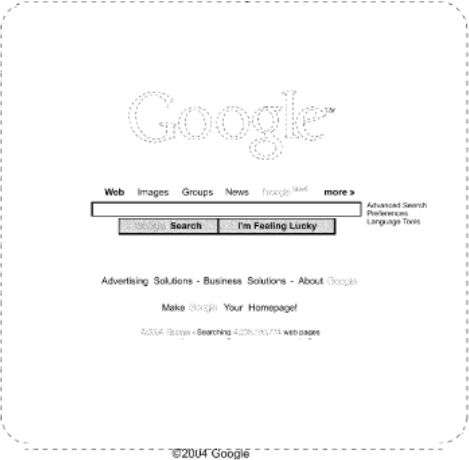
Now if your product is purely functional (say, just an L-bracket for supporting a shelf for instance), then you don’t really have anything aesthetic to protect, since the product is 100% functional in nature. But this is a rare case, and you likely wouldn’t be able to get a utility patent on such a simple item either. Also, if your product is a business method, software, or a chemical patent, then a design patent isn’t an option for you since there are no design attributes… although you can get a design patent on the software interface screen:
But even if your product doesn’t have a particularly unique look, or a look that can be easily designed-around, a design patent may help you in other ways. First, when you file a design patent, you have the right to say “Patent Pending.” You’re not required to indicate that it’s a design patent, and sometimes just having Patent Pending status opens doors that would otherwise remain shut. I’m not suggesting that you in bad faith imply that you have a utility patent application when you don’t, but certainly many people that can open doors for your product will either not care about the type of patent application you’ve filed or will not understand the difference when they ask if you you’re “Patent Pending.” The perception will likely be that you own the rights to the product.
Second, let’s talk price, using by example the flat-fee price structure of my firm, QuickPatents.com (which you should know is less than what a typical patent attorney charges since I’m a patent agent, not an attorney). A design patent application through us, as of 2015, is $895 plus the PTO filing fee of $190 (for micro-entities[4]). That will get you “Patent Pending.” In most of our cases the next correspondence that we get from the PTO is a “Notice-of-Allowance” (NOA), which means that the PTO Examiner has allowed the application and all that remains is to pay the issue fee (which is $140, plus our $90 processing fee). This NOA usually arrives 12 to 14 months after filing, and as of May of this year the term on design patents is 15 years. So for a total price of about $1,300 you get a patent that lasts for 15 years and has no further government “maintenance” fees (unlike utility patents). That’s less than $100 per year of protection.
Comparing that with utility patents, through our firm the cost on a non-provisional utility patent application is $3,495 for what we do, plus the $400 PTO filing fee, so right around $3,900 total. At this point you’re “Patent Pending” with a utility patent application. The likelihood of a rejection on a utility patent application from the PTO is about 95%, so you can expect that your application will be rejected at least once. We charge anywhere from $1,000 to $1,800 to respond to such an office action, depending on the strength and complexity of the rejection, and you may have to do this process twice, adding potentially another $3,600 over the next two or three years. Then, assuming we get a Notice-of-Allowance, the issue fee to the PTO and our processing fee is $330. Four years after the patent issues there’s a $400 maintenance fee, and then another at eight years of $900, and then another at twelve years at $1,850 (assuming the PTO prices won’t go up in the future, of course). So, all told, you could easily spend $8,500 - $11,000 over the life of the utility patent, or between $465 to $600 per year… at least five times the cost of a design patent. Now maybe your utility patent is so strong that it’s worth that extra expense… but remember that the allowance rate on utility patents, nation-wide, is about 53%[5], so you may spend up to $7,500 and, toss a coin, either get or not get your patent allowed some two to three years later. Comparing that to the 95% allowance rate on design patents after about a year, and the expected cost of a utility patent is about ten times that of a design patent. Sometimes it’s just a matter of economics that dictates what type of patent you apply for, and if funds are tight you may only have the option of a design patent if you want to be able to legally say “Patent Pending.”
Finally, and this may be the most important consideration, design patents and utility patents are not mutually exclusive. We’ve obtained both design and utility patents for the same product…
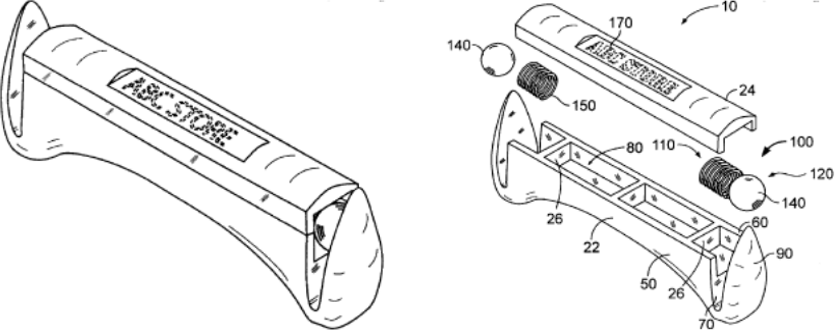
These two patents protect different aspects of this client’s invention, so he obtained all possible protection for his product. That’s a good thing to be able to tell your potential licensee, if you’re going that route. Plus, while both patents were pending he was able to legally say “Multiple Patents Pending.” That’s a bit stronger than just “Patent Pending,” and should give your competitor pause while they consider copying you or not. In this case, the design patent was filed a month after the utility patent, but was issued more than one year prior to the utility patent… meaning that the design patent was the first arrow in this client’s quiver, followed 15 months later by the utility patent. So even if you question the value or worth of a design patent, it may be the first weapon you can use while you’re waiting around for the government to examine your applications. And your design patent may end-up being the only patent you get, given the low allowance rate on utility patents. At the end of the day, if you have applied for both utility and design patents on your product, at least you have a good chance of being patented with the design patent if the utility patent is rejected and ultimately abandoned.
It should be pointed out that while you’re Patent Pending, you do not have any rights to stop your competitors from copying your product. I like to think of Patent Pending as a NO TRESPASSING sign on a piece of property that you don’t own yet. Legally being able to state “Multiple Patents Pending” is a bigger NO TRESPASSING sign, but still, if a competitor sets-up a lemonade stand on this property, you won’t be able to legally evict him until you own the deed to the property (that is, when one or more of your patents are granted). So the earlier you can obtain a patent, in the face of unfair competition, the better.
In my experience, design patents are usually a no-brainer for qualifying products. The cost is minor compare to that of a utility patent, the odds of getting the design patent approved are far higher, and the time before the patent is granted is usually months or years earlier. Why wouldn’t you at least file a design patent along with your utility patent?
So next time you’re discussing your utility patent with your patent practitioner, remember to ask about design patents. Having that extra arrow in your quiver might come in handy.
About the Author
Kevin Prince is a Registered Patent Agent, President of QuickPatents.com, inventor, and author of the book The Art of the Patent. He lives with his wife and nine children in Las Vegas, NV.
Notes
[1] Ant-like Persistence “2014 US Design Patent Toteboard,” https://blog.oppedahl.com/?page_id=464.
[2] U.S. Patent & Trademark Office, “U.S. Patent Statistics Chart 1963-2014,” http://www.uspto.gov/web/offices/ac/ido/oeip/taf/us_stat.htm.
[3] Christopher V. Carani, Esq., “Apple v. Samsung: Design Patents Take Center Stage,” http://www.americanbar.org/publications/landslide/2012_13/january_february/apple_v_samsung_design_patents_take_center_stage.html
[4] In this article, since many independent inventors fall into the micro-entity classification of making less than ~$155,000 per year and having filed fewer than five patents in their lifetime, we’ll use micro-entity government fees, which half as much as small entities falling outside of those ranges, and half again as much as large entities who have over 500 employees (these are general guidelines… see www.uspto.gov for more detailed information about your entity status).
[5] US PTO Data Visualization Center, UPR allowance rate, http://www.uspto.gov/corda/dashboards/patents/main.dashxml?CTNAVID=1005